SKILLS SPECIAL:
By the end of this issue, you will understand what a skill is, why it matters, and why the businesses using skills well will move faster than those that are not.
You will also see that not all skills are equal, and that the most valuable ones can be used to build, market and sell products.
That is why skill marketplaces are emerging, and why the smartest organisations are already building skills more like products than prompts.
The issue with Skills:
Many of the most valuable skills are being built by engineers and domain specialists. They are accessible via GitHub, but often require technical setup before you can see their value.
With an app, you can show someone the value instantly. With a skill, that is much harder. There is no homepage, no sign-in flow and no menu bar.
What is a Skill?
You will have heard more people talking about AI skills recently. They are going to be a theme for 2026.
The simplest way to think about a skill is as an app without a user interface.
It contains templates, workflows, logic, code and often access to tools, but instead of interacting with a webpage, you access it through a terminal or AI chat window.
A prompt is a one-off instruction. A system prompt sets the rules for how an AI should behave. A tool gives the AI a specific capability, like searching the web or calling an API.
A skill packages these elements to do a specific job reliably every time. It lets teams package useful capabilities before building a full software product.
Unlike a prompt, a skill compounds. Every refinement makes it more valuable. Over time, a strong skill library becomes a proprietary asset and a real advantage.
/Last30Days Skill
That really hit home when I discovered Matt Van Horn's /Last30Days skill.
Last30Days is a research engine. You ask any question and it pulls live data from Reddit, X, YouTube and advanced web search, then synthesises it into a structured report in about 60 seconds.
It shows where consensus is forming, what is gaining traction and where trends are emerging, from the places those conversations are actually happening.
It has become one of the first things I run before a client conversation, a brief or a strategy session.
Every strategic decision is only as good as the information behind it. Much of the information people still rely on is outdated, expensive or guesswork dressed up as strategy. With Last30Days, you are no longer guessing.
You know which ads are converting on any platform, which tools people are using, what users are asking for in a category, and what content is performing best for a given audience.
The commercial value of a product like this is obvious. The challenge is making that value visible to a non-technical audience.
I wanted to show colleagues and friends what this looked like in a format they could engage with immediately. You cannot show someone a skill in Cursor and expect them to get it.
So a couple of weeks ago I built a simple miniapp inspired by the skill to make the output visible, usable and easier to assess.
It took about two hours to create a working prototype. It works well as an internal tool or proof of concept.
The rest of this issue follows the same idea: putting a face on some of the most useful skills I have come across to show what they are capable of, and why businesses are leaving opportunity on the table by not taking full advantage.
*The official /last30days skill now includes TikTok, polymarket, Instagram + others - so it's extremely comprehensive!
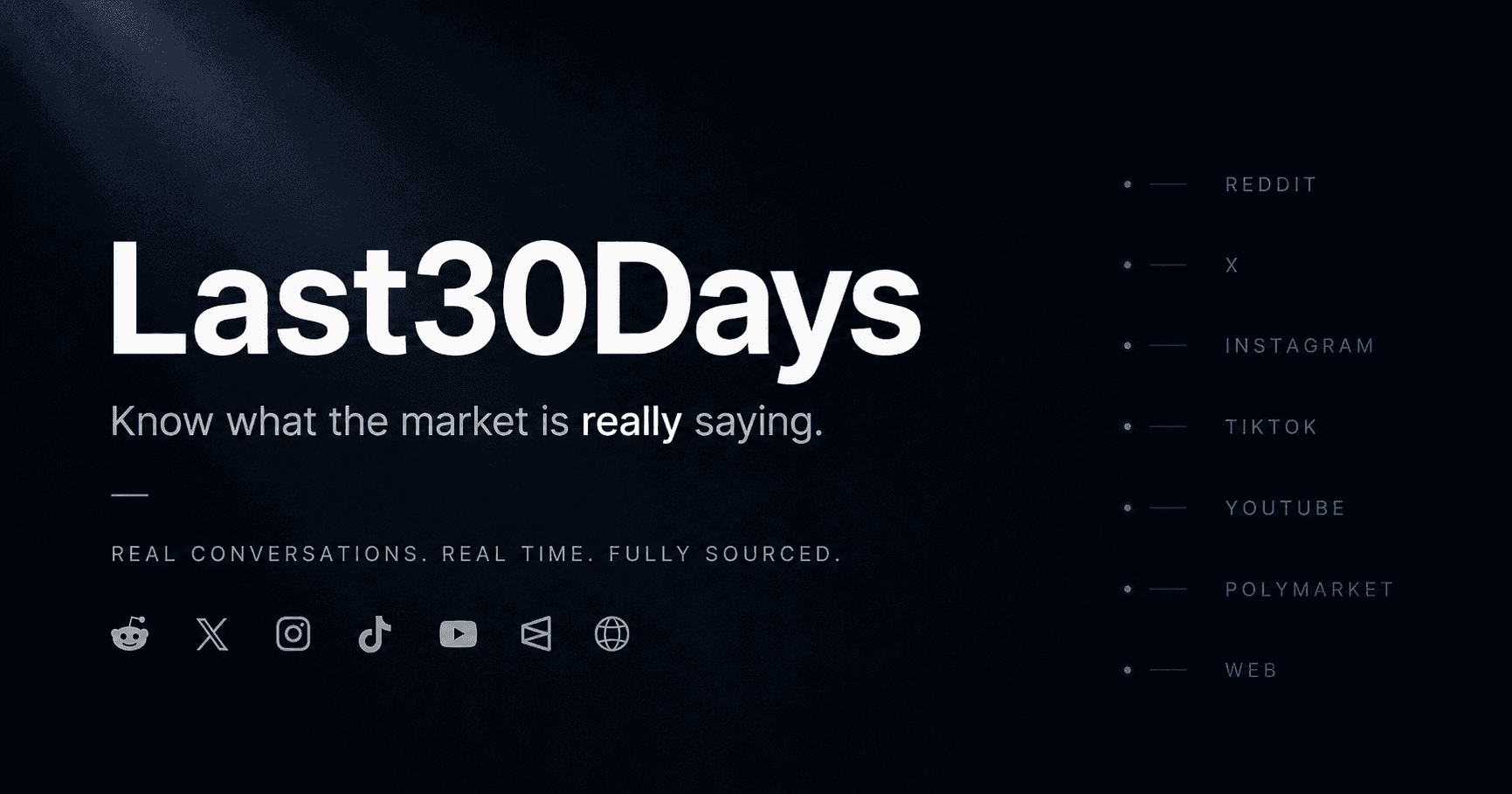
It's the first time I have felt a real gap emerge between the people who are capitalising on these capabilities and those who are not.
From Skill to Product
Once you have a valuable skill, the next question is: What can you build around it?
A strong skill is not just a back-end capability. It can become the foundation for a product, a landing page, campaign assets, positioning, copy and launch materials.
This is the playbook I would run:
Start with the capability. Turn it into something visible. Package it clearly. Position it properly. Then build the assets that help people understand it, buy into it and share it.
No 1 — Research
Research Prompt Template:
We are creating a /Last30Days-style research tool for [audience].
Define:
Audience: [audience + revenue range + industry]
Example: "2-10M SMBs in fintech struggling with AI adoption"
What makes this different: [unique approach or methodology]
Current state: [starting point]
Research goals:
Market landscape and key competitors
Customer pain points and positioning gaps
Pricing models and service packaging
Best practices worth repackaging for the target market
Tools for Research:
Perplexity MCP: deep market research
Brave Search: quick competitor lookups + Live information
Firecrawl: competitor websites at scale
Playwright: screenshots and pattern capture
The Golden Rule: Cast a wide net. Gather deep context. 30 to 60 minutes of serious research improves everything that follows.
Save the output as .md files in your project folder.
Also research keywords and create your brand kit at this stage. You will need both later.
Once you have the research and context, you can stack from there.
No 2 — Positioning Angles Skill
The positioning angles skill takes one product and generates multiple strategically different ways to talk about it.
Each angle comes with the logic behind it, the psychology it is tapping into, and the context in which it is most likely to convert.
This is not just generating hooks and hoping one lands.
It uses April Dunford's positioning method to clarify the real alternatives, differentiators and customer value. It uses Eugene Schwartz's market sophistication model to judge what kind of message the market is ready for. It uses Hormozi's value equation to anchor each angle in outcome, likelihood, speed and effort. It also draws on Todd Brown's unique mechanism thinking to explain why the promise should be believed.
It is then sharpened by the discipline of Halbert, Ogilvy, Hopkins and Kennedy.
The result is not vague creative output. It is a set of strategically different ways to position the same product, each grounded in positioning logic, buyer psychology and market awareness.
Behind these angles are frameworks such as market sophistication, unique mechanism, transformation mapping, contrarian positioning and competitive advantage framing. That is why the output feels strategic rather than generic.
No 3 — Direct Response Copy Skill
Once you have your positioning angles nailed - you can use skills like /directresponsecopywriting to draw on frameworks built on the classical advertising masters, adapted for modern internet writing. Start with the landing page copy.
The Frameworks it draws from:
Eugene Schwartz - Levels of Awareness: Know where the reader sits before you write.
Claude Hopkins - Reason why copy. Do not just claim something works. Explain why.
David Ogilvy: Headlines do the most work. Write like you talk. Show, don't tell.
Gary Halbert - Find a starving crowd first. Write to one person, not an audience.
John Caples - Self-interest beats cleverness. Curiosity alone is not enough. It needs to be paired with benefit.
Joseph Sugarman - Every element has one job: get the reader to the next element.
Robert Collier: Enter the conversation already happening in the reader's mind.
Best Used for: Landing pages, email sequences, sales copy, headlines, cold outreach and social posts. Anything where conversion matters.
The core principle: Write like you are talking to a smart, sceptical friend. Back every claim with specifics. Make the transformation clear.
No 4 — From Angles to Copy (Part 1)
The positioning angles skill defines the strategic frames. The direct response skill turns those frames into persuasive copy.
That is why the output feels sharp. It is not guessing. It is built on positioning logic first, then translated into direct response language.
Decision Intelligence Direct response logic: Turn weak market awareness into a business risk Line: "Every business decision made without knowing what the market is saying right now is a guess dressed up as strategy."
Honest Research Direct response logic: Use contrarian framing and specificity to challenge the old research model Line: "The most valuable market intelligence has not been filtered through a survey, a focus group or an analyst deck."
No 4 — From Angles to Copy (Part 2)
Democratisation / Paywall Enemy Direct response logic: Name the enemy and make the cost of the old way concrete Line: "40,000 a year and up before a single analyst logs in, and the output still needs human interpretation."
Unique Mechanism Direct response logic: Handle the obvious objection by defining what the product is not, then what it is Line: "Not a summary. Not a scrape. A defensible brief."
Secret Weapon Direct response logic: Use competitive advantage and loss aversion to push action Line: "The businesses acting on what the market is saying now are the ones that pull ahead. The ones that are not are already behind."
No 5 — The Front End Design Skill
Once you have the research, positioning and copy in place, you can start shaping the interface around them. The Front-end design skill is most useful when working from a strong brief.
What makes front-end design skills so useful is speed and range. With a strong brief, they can generate multiple different landing page directions in a short space of time. That helps you choose a direction faster, compare very different styles against the same strategy, and test what performs best.
What improves the output:
References: If you know the style you're aiming for, feed in examples. The result is far stronger than leaving the model to guess. Use sites like Siteinspire, viewport UI & Dribble to capture image references and learn terminology.
Brand kit: Bring your colours, typography and brand voice with you.
Context: Research, positioning angles and landing page copy give the design direction and structure.
This is where /Last30Days is particularly useful. It can help surface landing page references, UI patterns and design styles worth exploring before you start building.
No 6 — Launch Materials
Once you have the product, positioning, copy and landing page in place, you can shift to launch materials.
That can include email sequences, social copy, social graphics, lead magnets and even a launch video.
The /Last30Days video was built using Remotion - I'll do a deeper dive on that in a future issue - but for now, I've stopped at first pass because I set a hard limit on time spent here. It still makes the point that anyone can now create a strong product video by using AI skills to help bring the idea in your head to life.
Across this issue, I have taken one product through that full launch chain end to end. I took one skill, turned it into a product, built the positioning, translated that into copy, used that foundation to generate multiple landing page directions, and pushed it into launch materials.
That is the commercial advantage.
Businesses that know how to stack and build these skills can move from idea to market faster.
Businesses that are not using them are leaving value on the table.